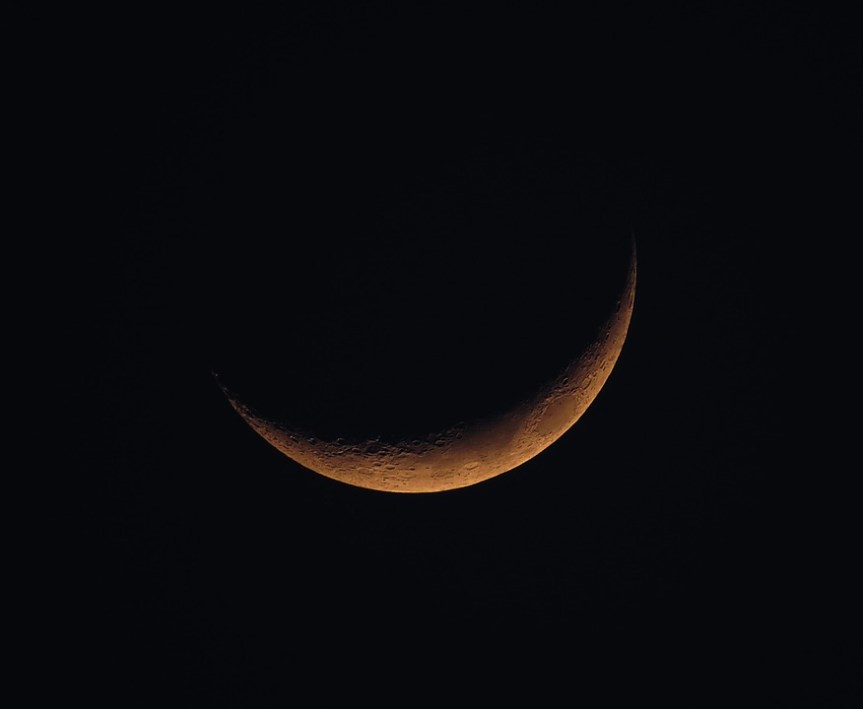
Shalom, Bnei Yisrael! Rosh Chodesh, which means “new moon,” “head of the month,” or “beginning of the month,” is the name for the first day of each month on the Hebrew calendar. In ancient pre-exilic Yisrael, the event of Rosh Chodesh was triggered by the sighting of the first visible crescent moon each lunar month. Rosh Chodesh is considered a minor biblical holiday, similar to the intermediate days of the holidays of Pesach (Passover) and Sukkoth (Feast of Booths).
Our Heavenly Father, YAH, commanded Bnei Yisrael to mark the occasion of the new moon as a time of recognition. In the Book of Numbers, YAH says to Moshe (Moses):
“Also in the day of your gladness, and in your appointed seasons, and in your new moons, ye shall blow with the trumpets over your burnt-offerings, and over the sacrifices of your peace-offerings; and they shall be to you for a memorial before Eloheikhem: I am YHWH Eloheikhem,”
Numbers 10:10
In ancient Yisrael, the occurrence of Rosh Chodesh was confirmed by the priests observing the new moon (first visible crescent). On the day after the new moon sighting, a festival was held to commemorate the occasion which included a convocation, the sounding of trumpets, and special sacrificial offerings. Rosh Chodesh was a very significant festival in ancient Yisrael. The entire calendar depended upon the declarations of Rosh Chodesh; without these declarations, there would be no way of knowing when the mo’edim were supposed to occur.
As a result of the Babylonian Exile, the post-exilic Yehudim adopted Akkadian | Babylonian names for each month on the Hebrew calendar. After the destruction of the Second Holy Temple in Jerusalem, the sighting of the first visible crescent moon was mathematically calculated using a fixed calendar developed by Rabbi Hillel II in the 4th century C.E. Over time, a custom developed whereby an additional day could be added to a month to ensure that certain holidays, for example, Yom HaKippurim, did not fall on days immediately before or after Shabbat (Sabbath | Seventh Day of the Week).
The Hebrew Calendar and Rosh Chodesh
There are a total of 12 or 13 months on the Hebrew calendar. Regular years have 12 months; leap years have 13 months. There are therefore 12 or 13 occasions of Rosh Chodesh during a calendar year on the Hebrew calendar. There are also two turns of the year on the Hebrew calendar. The ecclesiastical new year begins in the Spring on the 1st of Abib. The civil new year begins in the Fall on the 1st of Ethanim.
The following are the occasions of Rosh Chodesh using the names of the months on the Hebrew calendar, prior to the Babylonian exile:
| Rosh Chodesh | New Moon Lunar Month # | Month Name | Name Meaning Note | Season | Gregorian Months |
|---|---|---|---|---|
| First Month | Abib1 | “Spring, green ears (of corn)“ Note: The first day of Abib marks the ecclesiastical new year on the Hebrew calendar. | Spring | Mar – Apr |
| Second Month | Ziv2 | “Light, glow, or bright (flowers)” | Spring | Apr – May |
| Third Month | Mattan3 | “Gift (of crops)” | Spring | May – Jun |
| Fourth Month | Zabah4 | “Offering (of produce)” | Summer | Jun – Jul |
| Fifth Month | Karar5 | “Heat (of summer)” | Summer | Jul – Aug |
| Sixth Month | Tsahim6 | “Shining (of the sun)” | Summer | Aug – Sep |
| Seventh Month | Ethanim7 | “Perpetual (streams)” Note: The civil new year begins after Yom Shemini. | Fall | Sep – Oct |
| Eighth Month | Bul8 | “Rain (for crops)“ | Fall | Oct – Nov |
| Ninth Month | Marpa’im9 | “Remedies (of plants)” | Fall | Nov – Dec |
| Tenth Month | Pagrim10 | “Corpses (of plants)” | Winter | Dec – Jan |
| Eleventh Month | Pe’ulot11 | “Labors (of late planting)” | Winter | Jan – Feb |
| Twelfth Month | Hayir12 | “White (of frost)” | Winter | Feb – Mar |
| Thirteenth Month | Note: A 13th new moon is only counted in years when the signs of Spring have not been fully confirmed by the end of the 12th lunar month. | Winter-Spring | Feb – Mar |
- Nisan: “Month of beginning”
- Iyyar: “Rosette” or “blossom”
- Sivan: “Season” or “time”
- Tamuz: “Son of life”
- Av: “Father”
- Elul: “Harvest month”
- Tishrei: “Beginning”
- Cheshvan: “Eighth month”
- Kislev: “Thickened” or “condensed”
- Tevet: “Sink” or “Sink down”
- Shevat: “Strike”
- Adar: “Glorious?”
Holiday Observances
Rosh Chodesh is announced in community houses of worship on the preceding Shabbat after the reading of the Torah portion. A special prayer is recited beseeching The Creator for His blessing during the new month. The name of the new month, and the day of the week on which it will occur, is also announced during this special prayer.
On the day of Rosh Chodesh, some Torah communities read a special Torah portion, Numbers 28:11-15, and recite designated psalms including Psalms 104, 148, 113, 114, 117, and 118. The traditional greeting on Rosh Chodesh is “Chodesh Tov” wishing a good month to the recipient(s).
In some Torah communities, Rosh Chodesh is a day of rest for women. This is because, according to tradition, women in the Nation of Yisrael did not participate in the revelry of the Sin of the Golden Calf. Another explanation is the link between the lunar cycle and the menstrual cycle: A monthly renewal.
 Bnei Yisrael Standard