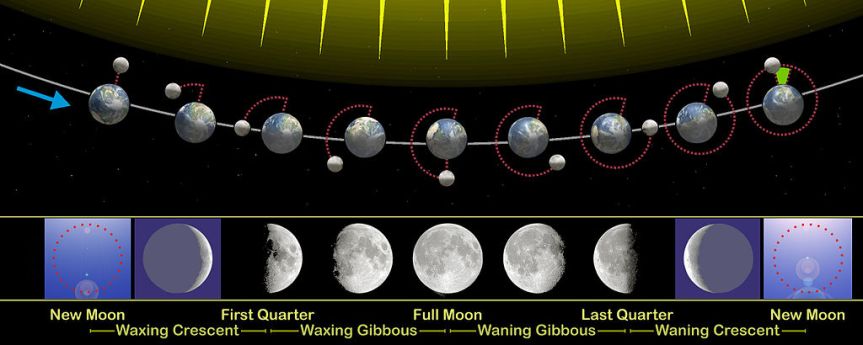
Shalom, Bnei Yisrael! Genesis 1:14-16 gives the account of Day 4 of the Creation in which Elohim divided the day from the night. He created two great lights, one with greater power than the other: The greater light, also known as the Sun, He created to rule the day; the lesser light, also known as the Moon, He created to rule the night. Elohim also created the stars to be used in conjunction with the Sun and Moon to assess the seasons, days and years. We will now explore the lesser light, the Moon, whose phases the ancient Bnei Yisrael used to track the mo’edim (appointed times).
The Moon
The Moon is the celestial object that orbits the Earth and is the Earth‘s only permanent natural satellite. The Moon is the second-brightest visible celestial object after the Sun in the Earth‘s sky. Elohim created the Moon as the lesser light to rule the night, however, the Moon does not shine its own light; it merely reflects the light of the Sun in a diminished form so that the Earth can experience nighttime. The Moon is in synchronous rotation with the Earth, that is, it will always show the same side to the Earth. This side is called the near side of the Moon. The far side of the Moon, the side that is never seen from the Earth, is also called the dark side of the Moon.
The Moon‘ has an elliptical (uneven) orbit around the Earth. Its orbital distance is approximately 384,402 kilometers/238,856 miles away from the Earth. The point when the Moon‘s orbit is closest to the Earth each month is called its perigee when the Moon is approximately 363,776 kilometers / 226,040 miles away. The point when the Moon‘s orbit is furthest from the Earth each month is called its apogee when the Moon is approximately 404,457 kilometers / 251,318 miles away. The Moon‘s apogee occurs approximately 14 days after its perigee each month. The point when the Moon comes nearest to the Sun is called its perihelion, which occurs annually approximately 14 days after the arrival of the Summer Solstice when daylight is longest. The point when the Moon is furthest from the Sun is called its aphelion, which occurs annually approximately 14 days after the arrival of the Winter Solstice when daylight is shortest. The Moon has a gravitational influence on the Earth‘s crust and ocean tides. The shape of the directly-lit portion of the Moon‘s surface as viewed from the Earth is called the lunar phase or the phase of the Moon.
The Lunar Phases
As mentioned previously, the shape of the directly-lit portion of the Moon‘s surface as viewed from the Earth is called the lunar phase. The lunar phase changes gradually and cyclically over a period of approximately 29.5 days, as the Moon orbits around the Earth, and the Earth orbits around the Sun. The Moon makes a complete orbit around the Earth in relation to the fixed stars about every 27.3 days (sidereal period) however; because the Earth itself is rotating and has its own orbit around the Sun, it takes longer for the Moon to show the same lunar phase to the Earth, visually extending its monthly orbit to 29.5 days (synodic period). The lunar calendar year has about 354 days, about 11+ days shorter than the solar calendar year of 365.2425 days.
The following is a list of the lunar phases (phases of the moon) occurring during each lunar month. Each lunar month is about 29.5 days. The images presented are the view of the Moon from the Earth‘s Northern Hemisphere. The view from the Southern Hemisphere would be 180-degrees opposite (upside down):
| Lunar Phase | Visibility from Earth | Average Moonrise | Average Moonset | Illumination (Northern Hemisphere) | Illumination (Southern Hemisphere) | View from Northern Hemisphere |
|---|---|---|---|---|---|---|
| Dark Moon | None | 6 am | 6 pm | Disc completely in Sun’s shadow | Disc completely in Sun’s shadow | None |
| Waxing Crescent Moon | Late morning to post-dusk | 9 am | 9 pm | Right side, 1–49% lit disc | Left side, 1–49% lit disc | 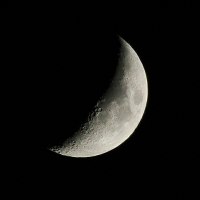 |
| First Quarter Moon | Afternoon and early evening | Midday | Midnight | Right side, 50% lit disc | Left side, 50% lit disc | 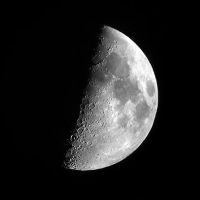 |
| Waxing Gibbous Moon | Late afternoon and most of night. | 3 pm | 3 am | Right side, 51–99% lit disc | Left side, 51–99% lit disc | 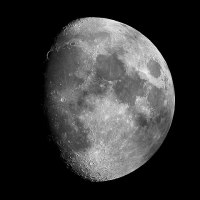 |
| Full Moon | Sunset to sunrise (all night) | 6 pm | 6 am | Completely illuminated disc | Completely illuminated disc | 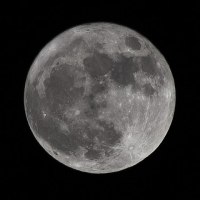 |
| Waning Gibbous Moon | Most of night and early morning | 9 pm | 9 am | Left side, 99–51% lit disc | Right side, 99–51% lit disc | 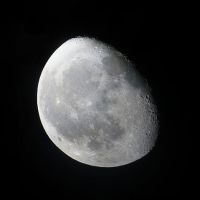 |
| Third (Last) Quarter Moon | Late night and morning | Midnight | Midday | Left side, 50% lit disc | Right side, 50% lit disc | 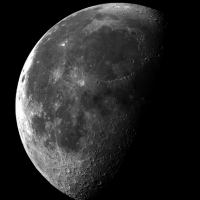 |
| Waning Crescent Moon | Pre-dawn to early afternoon | 3 am | 3 pm | Left side, 49–1% lit disc | Right side, 49–1% lit disc | 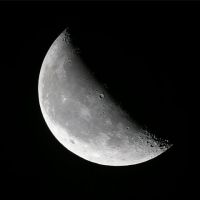 |
The Lunar Months and Mo’edim
The lunar calendar utilizes the lunar phases to track time during a lunar month. Each new moon marks the beginning of a new month, each month being about 29.5 days, and each lunar year having 12 or 13 moons. In ancient Bnei Yisrael culture, the new moon or first visible crescent (FVC) that marked the beginning of the month. The Bnei Yisrael were later commanded to celebrate each new moon with a monthly “new moon day” festival called Rosh Chodesh.
The following is a list of the lunar months on the Hebrew calendar and their respective mo’edim:
| New Moon # and Lunar Month | Given Name | Season | Mo’edim |
|---|---|---|---|
| 1. First Month | Abib | Spring | Rosh Chodesh Month 1 | Abib, Ecclesiastical New Year, Pesach | Passover, Chag HaMatzot | Feast of Unleavened Bread, Yom HaBikkurim | Day of First Fruits Sefirat HaOmer | Counting of the Omer |
| 2. Second Month | Ziv | Spring | Rosh Chodesh Month 2 | Ziv, Pesach Sheni | Second Passover, Sefirat HaOmer | Counting of the Omer |
| 3. Third Month | Mattan | Spring | Rosh Chodesh Month 3 | Mattan, Sefirat HaOmer | Counting of the Omer Chag HaKatzir | Feast of the Harvest, a/k/a Shavuot, Feast of Weeks |
| 4. Fourth Month | Zabah | Summer | Rosh Chodesh Month 4 | Zabah |
| 5. Fifth Month | Karar | Summer | Rosh Chodesh Month 5 | Karar |
| 6. Sixth Month | Tsahim | Summer | Rosh Chodesh Month 6 | Tsahim |
| 7. Seventh Month | Ethanim | Fall | Yom Teruah | Day of Blasting, Yom HaKippurim | Day of Atonements, Chag HaAsif | Feast of the Ingathering, a/k/a Sukkoth, Festival of Booths, Civil New Year |
| 8. Eighth Month | Bul | Fall | Rosh Chodesh Month 8 | Bul |
| 9. Ninth Month | Marpa’im | Fall | Rosh Chodesh Month 9 | Marpa’im |
| 10. Tenth Month | Pagrim | Winter | Rosh Chodesh Month 10 | Pagrim |
| 11. Eleventh Month | Pe’ulot | Winter | Rosh Chodesh Month 11 | Pe’ulot |
| 12. Twelfth Month | Hayir | Winter | Rosh Chodesh Month 12 | Hayir |
| 13. Thirteenth Month | Winter-Spring | Rosh Chodesh Month 13. Note: A 13th new moon is only counted in years when the signs of Spring have not been fully confirmed by the end of the 12th lunar month. |
The lunar calendar year has about 354 days, about 11+ days shorter than the solar calendar year of 365.2425 days. For this reason, if operating solely off a lunar calendar, the dates for the mo’edim would be out-of-sync and move across the seasons. To prevent this from happening, it is necessary to add intercalary days to keep the calendar in sync with the solar calendar year so that the dates for the mo’edim may be accurately determined. By adding intercalary days, the calendar becomes a lunisolar calendar, utilizing the positions of the Sun, the Moon and the constellations. The ancient Bnei Yisrael used a lunisolar calendar model to track both civil business and the mo’edim, with the civil year beginning in the Fall, and the ecclesiastical year beginning in the Spring.
 Bnei Yisrael Standard